



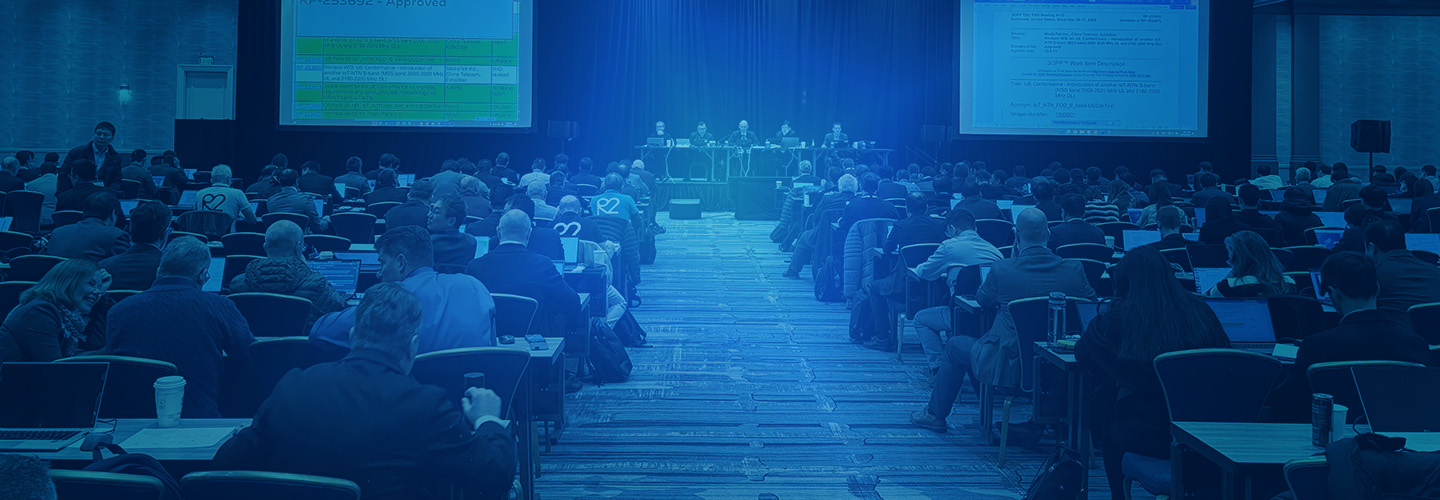
This blog post is part of the “Tech Talk” series focused on the First Responder Network Authority’s (FirstNet Authority) standards development activities to support public safety. This post recaps discussions linked to public safety and other related topics from the 3GPP plenary meetings that were conducted in December 2025. The FirstNet Authority represented public safety interests at the plenary meetings.
A recap of discussions linked to public safety and other related topics from the 3GPP Plenary meetings that were conducted Dec. 8-12 in Baltimore.
It’s an important reminder that standards impact all of us. They create consistency and a level playing field for industry providers and ultimately make things better for consumers. Think of your mobile phone—have you ever wondered why an iPhone can call, text, connect to the internet, and send pictures to your friend’s Android, Nokia, or Ericsson device? Or why, when you arrive in a different country and power on your phone, it simply connects and starts working? It’s because of the global wireless standards.
This is why the FirstNet Authority drives standards for public-safety telecommunications so they will seamlessly work. In an emergency, public safety needs devices that are reliable and easy to operate. In 2012, Congress passed a law that created the FirstNet Authority and called for the FirstNet network to be based on 3GPP standards. Congress recognized the importance of standards and required the FirstNet Authority to work with standards organizations, such as 3GPP, and ensure that public safety’s needs are represented in these discussions. Not only do standards help promote consistent safety, quality, efficiency, and compatibility, but they also help drive innovation for first responders today and tomorrow. The FirstNet Authority also works with the Department of Commerce and other U.S. agencies to ensure that the American public is served.
In December 2025, the FirstNet Authority standards team participated in the quarterly 3GPP Technical Specification Group (TSG) meetings in Baltimore, MD which included all three 3GPP TSGs – Radio Access Networks (TSG RAN), Service and Systems Aspects (TSG SA), and Core Network and Terminals (TSG CT).
3GPP is a global partnership focused on developing specifications for mobile technologies by bringing together organizations and companies from around the world. The TSG meetings (often called “plenaries”) take place quarterly, but there are also working groups under the TSGs that meet once or twice between plenaries to focus on more detailed technical activities. These meetings are to ensure compatibility between different networks and vendors.
The highlights of the week included the declaration that Release 19 (R19) specifications are frozen, and all the working groups are now focused on Release 20 (R20), particularly the 6G study activities. With R19 being declared frozen, the only work allowed for this release going forward is corrections and errors found during implementation activities or testing.
The following sections include details on each of the 3GPP TSG meetings, along with input from the TSG working groups, focused on progressing high-priority features to public safety.
The Radio Access Network (RAN) TSG Plenary
The RAN Plenary is responsible for defining the requirements, functions and interfaces of the 3GPP radio access network (RAN). More than 300 attendees participated.
The FirstNet Authority continues leading and championing the advancements of public-safety communications into the global standards of 3GPP including current work for 5G-Advanced (5G-A) and 6G. Representing public safety’s voice is unique to the FirstNet Authority and something that few other organizations do. The FirstNet Authority is widely considered the expert in this area.
R20 includes normative work, which establishes rules, specifications and criteria, for features related to 5G-A and study on 6G. R20 is the sixth release of 5G and the third release of 5G-A, focusing solely on addressing critical commercial needs.
During conversations at the RAN Plenary meeting, many in the industry expressed the expectation that 6G will be AI-ready and built on the foundations of 5G networks, evolving from service-based architecture. There were discussions around 6G being value-driven, with features introduced only where they address verified operator and societal needs. The group also discussed the following priorities:
While these principles may seem relatively straightforward, some of them come at the cost of others, so there is still much work needed in 3GPP to harmonize these concepts. The FirstNet Authority expects compromises and concessions as discussions progress.
Much of the RAN Plenary meeting focused on the continued advancement of—and agreements to—the 6G study item and clarifying the task that should be the focus. Some areas of continued discussion included 6G device types, spectrum, peak throughput values and targets, artificial intelligence and machine learning (AI/ML) traffic and use cases, 6G RAN architecture, 6G key performance indicators (KPIs), 6G non-terrestrial network (NTN) operation on terrestrial network (TN) bands, and testing/certification requirements.
The FirstNet Authority provides details on the progress status of features important to public safety for R20 and prior releases below.
The RAN1 working group is responsible for the specification of the physical layer of the radio interfaces. The working group reported progress (12% completed) on the 6G Radio (6GR) study, with waveform and channel coding being in good shape where core parts are almost confirmed.
Additionally, further studying for necessary enhancement of polar code and low-density parity-check code beyond 5G new radio (NR) range is in progress. The 6GR study progressed well, with comprehensive discussion on topics like general evaluation assumptions, traffic models, network and UE power-consumption models, and categorizing AI/ML use cases.
The working group also began work on the R20 5G NR study and work items of high-priority features relevant to public safety, reporting good progress on these features. These items included:
- Study on Global Navigation Satellite System (GNSS)-resilient NR NTN operation (50% completed).
- Study on Integrated Sensing and Communication (ISAC) for NR (58% completed).
- Study on enhancements for solutions for Ambient Internet of Things (IoT) in NR (75% completed).
- Normative work on AI/ML for NR Air Interface enhancements (20% completed).
- Normative work on solutions for Ambient IoT in NR phase 2 (5% completed).
- Coverage enhancements for NR Phase 3 (28% completed).
Public-safety operations stand to benefit significantly from these features and innovations. GNSS-resilient NR NTN operation will enable 3GPP NR NTN systems to remain accessible when GNSS information in UE is temporarily unavailable or degraded, leading to a reduction in GNSS position accuracy.
Ambient IoT allows wireless sensors to derive energy from solar and/or wind power, eliminating the need for frequent change of batteries. ISAC lets the network collect data on the range, velocity, position, size, and even the materials of objects in coverage areas to meet the situational awareness needs of public safety.
The RAN2 working group is responsible for defining radio-interface architecture and protocols. The working group reported completion—i.e., Abstract Syntax Notation One (ASN.1) ready to be frozen—of all the R19 study and work items for high-priority features relevant to public safety including the completion of the FirstNet Authority-championed feature, NR sidelink multi-hop U2N (user equipment to network) relay. Other completed high-priority R19 public-safety features include:
- NTN for NR, IoT NTN, and inter Radio Access Technology mode mobility for supporting mobility between LTE TN to NR-NTN.
- NTN for NR enhancements expand coverage beyond terrestrial mobile networks (e.g., to rural and remote unserved and underserved areas).
- IoT NTN enhancements are important to provide connectivity beyond coverage of terrestrial networks for IoT sensors and devices, which can be integrated with—and relied upon—by the public-safety systems.
- RAN2 has started R20 6G Study, reporting steady progress and constructive discussions. The working group has also started work on R20 5G NR features such as AI/ML for mobility in NR (7% completed), and voice over NTN (10% completed under work item NTN for IoT Phase 4).
- The RAN3 working group is responsible for the overall Universal Terrestrial Radio Access Network (UTRAN)/Evolved Universal Terrestrial Radio Access Network (E-UTRAN)/Next Generation Radio Access Network (NG-RAN) architecture and the specification of protocols for the related network interfaces.
The working group has reported solid progress on the R20 5G NR public-safety-relevant feature study on AI/ML for NG-RAN Phase 3 (70% completed). This study item is to further investigate new AI/ML-based use cases and identify NG-RAN functionalities enhancements on top of the outcomes of the Release 18 normative work (AI/ML based Load Balancing, Energy Saving, and Mobility Optimization), and the R19 normative work (AI/ML-based Network Slicing and Coverage and Capacity Optimization). The study focuses on evaluating AI/ML-based mobility use cases, including multi-hop UE trajectory across Next Generation Node Bs (i.e., 5G NR base stations), lower-layer triggered mobility, and other handover enhancements.
RAN3 also reported the beginning of the 6G study with strong interest from companies in 6G related discussions and initial focus on RAN3-led topics such as 6G RAN architecture, including data collection, RAN-CN interface—including point-to-point vs. service-based interface—ad RAN internal interfaces including higher layer split.
The RAN4 working group is responsible for work on radio-frequency aspects, including performing simulations and deriving the minimum requirements for transmission and reception parameters for UE devices.
The RAN5 working group is responsible for the development of UE conformance test specifications and typically works one to two releases behind the other working groups.
The working group reported completion of FirstNet Authority-driven public-safety work items on the UE Conformance - Protocol enhancements for Mission Critical Services (MCS), including Mission Critical (MC) Push-to-Talk, MC Video, and MC Data for Rel-17 over LTE and 5G.
The working group also reported completion of other significant public safety-related UE conformance test specifications, including R17 NR sidelink single-hop U2N relay, UE Conformance Solutions for R17 NR NTN, and R18 UE Conformance for IoT NTN. The group reported steady progress of high-priority public-safety-relevant work on UE Conformance Solutions for R18 NR NTN (35% completed).
The Service and System Aspects (SA) TSG Plenary
The SA Plenary is responsible for the overall architecture and service capabilities of 3GPP-based systems. The meeting included more than 225 attendees.
The 3GPP SA Plenary mainly focused on the progress of R20 5G-A and R20 6G studies, as well as initiating the discussions on Release 21 (R21) 6G normative work timeline.
R20 5G-A included several public-safety high-priority features, such as proximity-services (ProSe) enhancements to support UE-UE multi-hop communications, integration of NTN in the 5G architecture, AI/ML enhancements, integrated sensing and communications, Ambient IoT, and extended reality and media services (XRM). There was extensive discussion regarding the final scope of the R20 6G studies and roles and responsibilities of the different working groups to address certain aspects (e.g., AI and APIs).
The timeline for R21 was briefly discussed; it is expected that 3GPP members will share their views of R21 timeline during the upcoming March 2026 Plenary meeting. The final timeline will be agreed to during the June 2026 Plenary meeting. R21 will provide the first normative set of technical specifications for 6G. R20 will only generate technical reports as outcomes of 6G studies.
The SA1 working group is responsible for the services and system requirements and typically works one release ahead of the other 3GPP working groups. SA1 reported that all 5G-A work items are complete for R20. This is designed to let other SA working groups focus better on their needed work.
The 6G study in SA1 is 80% complete and currently includes more than 200 different use cases. The group completed the use-case development work and—as of the February 2026 meetings—has completed consolidation of the requirements and KPIs.
The SA2 working group is responsible for the 5G System and evolved packet system architecture. SA2’s focus since the last plenary meeting has been to advance R20 5G-A and R20 6G studies.
SA2 reported 100% completion of the ProSe specifications to support UE-to-UE multi-hop and more than 75% completion of the 5G-A architecture technical reports of other public-safety high-priority features. These features include:
Integration of satellite components in the 5G architecture, integrated sensing and communication, core network enhanced support for AI/ML, and architecture support of ambient power-enabled IoT.
SA2 also reported 20% completion of 6G system architecture technical report, which includes 24 key aspects under this R20 6G study.
SA2 is considering adding ad-hoc meetings to ensure achieving the March 2027 completion date for R20 6G study.
The SA3 working group is responsible for 5G and future 6G security aspects. The working group is advancing work on transitioning to Post-Quantum Cryptography (PQC). This work is seen as the next step in the PQC transition and will ensure that 3GPP systems can leverage the latest quantum-safe cryptographic algorithms when needed.
SA3 reported progress specifying how security-related events are handled in 5G-A, enabling more granular control for protecting 5G networks. As R20 continues, the security working group will allocate more meeting time to progress the 6G security study.
The SA6 working group develops the architecture for most mission-critical features. Much of the SA6 time is now focused on R20 work. The work is divided between 5G-A enhancements and early R20 6G study work in application enablement.
The study for MCS over 6G has not started. The group is waiting until the underlying work is further advanced and greater clarity exists. The FirstNet Authority expects the MCS over 6G to start in the second quarter of 2026.
The mission-critical work in SA6 is now focused on defining R20 features and studies. There are several study items and work item descriptions of public-safety interest. These include discreet listening and monitoring of MCS, logging and recording of MCS, continued enhancements to MCS, and support for MCS over multi-hop relay (both UE-to-UE and UE-to-Network).
Discreet listening and monitoring will allow an authorized party to remotely enable listening to a UE in an ongoing situation, without any action required from public-safety personnel operating the UE. This is important for hostage situations or when public-safety personnel cannot be contacted.
The logging and recording feature will allow MC service to be recorded for future use. The enhanced MCS work is focused on continued improvements and corrections to the existing MCS capabilities. The MCS over multi-hop is the same as the R19 single-hop service, but it allows for as many as two additional relays. This work was completed and is moving forward for the CT working groups to begin the protocol definitions.
The Core Network and Terminals (CT) TSG Plenary
The TSG CT Plenary group covers the protocol details that follow and support the requirements and architectural work defined by the TSG SA groups. The CT Plenary meeting included more than 190 attendees.
The CT group reported continued progress on R19 features. The work in the CT working groups is based on completed SA2 and SA6 architecture work. The CT working group, particularly CT1, reported 100% completions of all public-safety high-priority features. These features include the protocol work to support MCS, enhanced location for MCS, and 5G ProSe phase 3, a study on system enhancements for ProSe.
The CT group also reported on defining R20 6G studies, but work is needed to fully define their scope for 6G studies, because of their dependencies on SA2.
Further information on the 3GPP’s work and organization can be found at: www.3gpp.org.
Contributors to this article include FirstNet Authority Senior Standards Engineers Ihab Guirguis and Satish Jha, Electronics Engineer Gigy Mammarappallil, and the National Institute of Standards and Technology’s Jeff Cichonski.