Summary
Guest
Gerald Risner, Senior Public Safety Advisor, FirstNet Authority
Drew Chandler, Emergency Management Director, Woodford County
Bruce Fitzgerald, Senior Emergency Management Advisor, FirstNet Authority
Transcript
Preview
Narrator: You're listening to Public Safety First, a podcast to help you learn about the First Responder Network Authority and how you can be part of the future of public safety technology.
And now, your host.
Gerald Risner: Hello, I'm Gerald Risner with the FirstNet Authority. I'm sitting here today with Drew Chandler, who is the Emergency Management Director for Woodford County, Kentucky, and Bruce Fitzgerald, who is our Emergency Management Advisor for the FirstNet Authority. So, Drew, as we are talking about all things emergency management today, what are the communications challenges that your organization faces?
Narrator: You're listening to Public Safety First, a podcast to help you learn about the First Responder Network Authority and how you can be part of the future of public safety technology.
And now, your host.
Gerald Risner: Hello, I'm Gerald Risner with the FirstNet Authority. I'm sitting here today with Drew Chandler, who is the Emergency Management Director for Woodford County, Kentucky, and Bruce Fitzgerald, who is our Emergency Management Advisor for the FirstNet Authority. So, Drew, as we are talking about all things emergency management today, what are the communications challenges that your organization faces?
Drew Chandler: Well, they're probably like most other public safety organizations. You know, we have dynamic needs. We have good coverage most of the time in most areas. But, Murphy says that when we need to communicate, it might be in an area where there's communication challenges. The best thing that we have is to have redundant tools, and that gives us opportunities to overcome any unforeseen obstacles or address issues in areas that we know we have communication gaps.
Bruce Fitzgerald: Let's talk a little bit about that issue in the state of Kentucky — kind of the state of affairs of emergency management, and the climate that you guys deal with, what some of your hazards are, and some of the things that you worry about day to day?
Drew Chandler: Kentucky gets it all. We get winter weather. We get floods. We get severe winds. We get — drought is an active issue that's going on right now. So, our ability to respond to any of those situations, or any other that you can think of, is wholly dependent on our ability to communicate effectively. It is important for us to evaluate our communications plans so that we have all the resources that our stakeholders need to help us prepare, respond, and recover.
Gerald Risner: So, you mentioned those tools. Tell us a little bit about how you've incorporated FirstNet in your daily operations, and how you might use it on a daily basis?
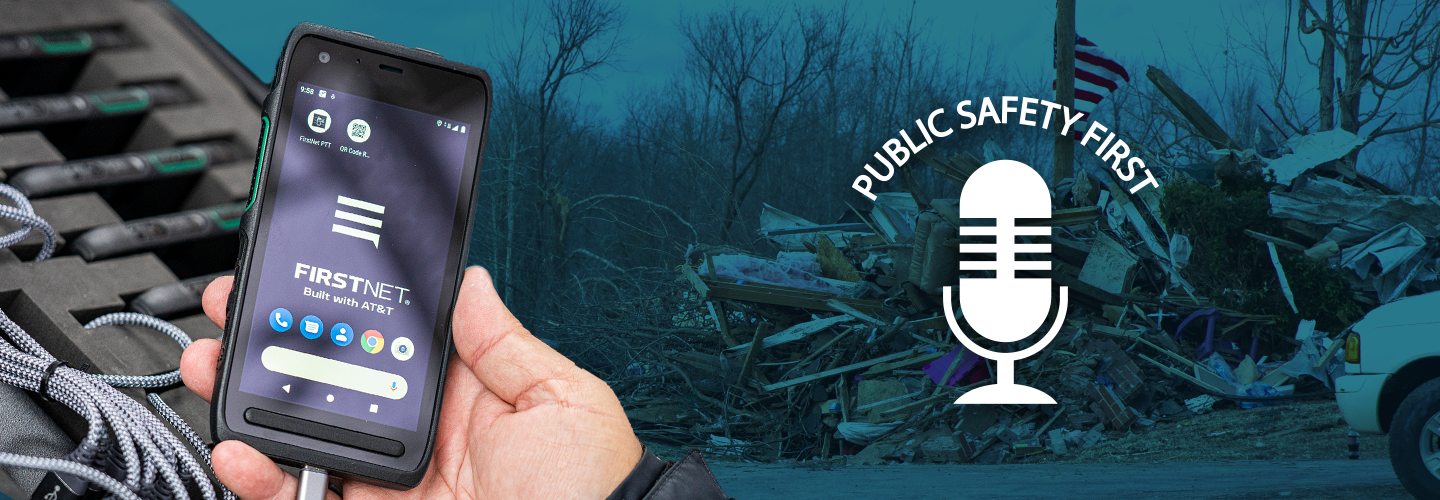
Drew Chandler: FirstNet is one of the primary tools that we use. We have LTE equipment and 5G equipment that we keep active 24/7, and we have equipment that we can activate in an expedited manner when the need arises. That ranges from cached, cellular handheld devices like we all carry around in our pockets if we have some folks coming from out of town or need a specific application that's unique to our community — like a push-to-talk radio app. We also have the data packets that we can install, even on a boat. Our whole western border is a river. So, when we're out doing damage assessments, being able to do those real time capture of coordinates and get it uploaded to the damage assessment maps is essential, and a handheld device just doesn't cut it. So, you have to have the equipment with a larger antenna, more wattage.
Gerald Risner: So, what is it that you think public safety, specifically those in your field of emergency management, should know about?
Drew Chandler: Well, the first thing would be not to take it completely for granted. You have to have diverse resources, and you have to understand the optimal conditions that those pieces of equipment can work on so that you have realistic expectations for what you could get out of it. Then you also have to think about contingencies for when they don't work optimally and have alternative connections. You know, the FirstNet Authority has some great packages that have redundant backhauls. So, if one particular method of communicating out of that site isn't working, there's a different pathway. So, we had a session earlier today, and the adage about “two is one and one is none” came up, and a lot of the FirstNet equipment delivers on that methodology by having the redundant pathways.
Gerald Risner: Okay, I want to thank you. You've been willing to serve on the FirstNet Authority Emergency Management Cohort. You’re valuable insight from boots on the ground. Talk a little bit about that experience. I know from our side of the house where it pertains to FirstNet, that's what drives us, right? Knowing what's needed from the field. So, talk a little bit about that.
Drew Chandler: It was actually a funny coincidence that between sessions of the IAEM (International Association of Emergency Managers) conference in Colorado Springs last winter, we had come across a social media post about applying to the EM (Emergency Management) Cohort. I sent an email and immediately got an Out of Office because somebody was at the IAEM conference. So, I went to the FirstNet booth and got to apply face-to-face, in-person. So, that went really well, but the takeaway from that is, you know, FirstNet is where we are. And knowing that they're represented at the Kentucky Emergency Services Conference in Louisville or at the IAEM conference in Colorado or wherever those happen, that we have people that have been practitioners that are in roles to help govern this system and be liaisons that understand some of the challenges that we face. And then to get to interact with colleagues in the EM Cohort from every geographic area across the U.S.— from high population urban centers to the most rural of the rural where satellite is a primary communication method — and getting to interact with them and exchange, not necessarily war stories, but how we overcame different obstacles partially using the FirstNet capabilities and incorporating them into daily and disaster time operational plans.
Bruce Fitzgerald: So, Drew, we were really glad to have you be part of our Cohort. We've had emergency managers from state, county, local, federal, tribal levels and from all corners of the country. So, it's been a really great experience for us on the FirstNet Authority side to hear how emergency managers are using FirstNet every day, and then how you're using it in an emergency as well, both for mutual aid and how you're doing your response. You mentioned damage assessments. So, we had another Cohort member talking about doing mobile damage assessments over a FirstNet enabled device. So, it's great for us to be able to hear those uses because then we go back and we coordinate with our partner and the industry as a whole to say, “This is what emergency managers need. FirstNet needs to be able to do these things for them so that they can do their job.” What were some of the things that you learned from other emergency managers through that conversation?
Drew Chandler: Well, it just reinforced our PACE (Primary, Alternate, Contingency, Emergency) planning. You know, and just really helped us articulate to our elected officials — that have the ultimate say so on our budgets and how we invest in technology to respond — and being able to share the problems that we're having and challenges that we're trying to solve through these technology investments are the same things that are happening in other places. It's not just us communicating that. It is an identified challenge that is common to all of us. And how the different applications in the app catalog get utilized, I'm particularly intrigued and investigating how we might be able to invest in the push-to-talk and radio over IP. There's just a lot of opportunity.
Bruce Fitzgerald: And when somebody comes in from away, whether it's a local mutual aid or from out of state to help you, you need to be able to incorporate them into your communications very quickly.
Drew Chandler: Absolutely. And again, it is about having multiple methods to solve communication challenges.
Bruce Fitzgerald: Yeah, do you have your own deployable assets?
Drew Chandler: We keep a small cache of some cellular modems. Some are active in an antenna suitcase model, and we have some that are no-use SIMs just packaged in a case, ready to deploy, and have a little laminated instruction card on the inside. We are working with our State Office of Homeland Security and are very hopeful that we will be able to add a larger deployable to our cache. Our leadership in Woodford County is very supportive of us going beyond that county boundary. They are huge proponents of regional response and concepts because they know that one day, if we are helping our neighbors, that we're more likely to get help in return. And, you know, we don't want to wish a disaster on anybody, but it's going to happen to us again. In fact, you know, we've had two presidentially declared disasters for flooding this calendar year, and we did have other communities come and help us.
Bruce Fitzgerald: How important is it to be able to deploy those assets on your own schedule and when you know that you need them, rather than having to call and ask for help and wait for that help to arrive, like, you own those kits and you can roll those out whenever you need to?
Drew Chandler: Well, I would preface the response by saying that the timeliness of being able to get deployables has never been a concern, both for the incidents and planned events that we've had ourselves, and also some Type One Incidents that have happened in Kentucky over the last half decade. And FirstNet has been there every time. So, our interest is a little self-serving. We want some redundancies and capabilities that we don't have on hand now, but we also don't want to be a burden or fully dependent on being able to bring those resources in, because if something were to happen, we might be on a longer timeline to get some of those. And you know, when you can plug in a resource, such as a CRD, into the main security appliance at your main center of government facility and allow the phones to continue ringing like nothing happened, there's a lot of value in that. And knowing that you have it in a warehouse across town and it's just a matter of getting it across town, and that it was updated last month like it was supposed to, is a big peace of mind, and it's a big part of the PACE planning process as well.
Bruce Fitzgerald: Sure. So, I'm learning, after being here for a couple of days, that there is a lot going on in Louisville and in this area. You’ve got a lot of big events that happen and they're getting bigger as the years go by. Can you talk to us a little bit about how FirstNet, particularly the priority and the preemption and kind of those core features of FirstNet, how does that help when you have 70,000 people show up for a few days?
Drew Chandler: Well, even bigger than that. Louisville throws a two-minute party called the Kentucky Derby annually here for the last 151 years. I know the Louisville Communications Group has a lot of support from FirstNet. So, something as high profile as the Kentucky Derby, to one of the biggest concerts that happens in Kentucky, with the one that you're referencing, knowing that the responders will be able to communicate when you have that many people in a small, concentrated area is critical. Theres other considerations, too, because it's loud. It's a concert, and there's some technology available that interacts with cell phones that I don't believe is available on LMR (Land Mobile Radio) systems as far as audio suppression and noise canceling. Plus, it's in their pocket, right? You hook a battery booster to it. You go through your shift. Your device stays charged. It has the priority and preemption, so, you know when you need to make a call or you have something out of the app catalog to triage patients or update situational awareness about the event, you know that it's going to reach its destination and that you will receive timely information as well.
Gerald Risner: So, as we wind down, we want to thank you for your hospitality, Drew. And it's refreshing to know that the emergency management community is so active in this area, right? That folks like yourself are forward thinking in using today's technology and emerging technologies. And from the FirstNet Authority, again, we say thank you and we appreciate it.
Drew Chandler: And we thank you for being here and supporting us in our mission.
Narrator: Thanks for listening today. We're excited to have you join our podcast community. Make sure to subscribe on iTunes, SoundCloud, and YouTube. You can learn more about the First Responder Network Authority at FirstNet.gov and learn about FirstNet products and services at FirstNet.com.