



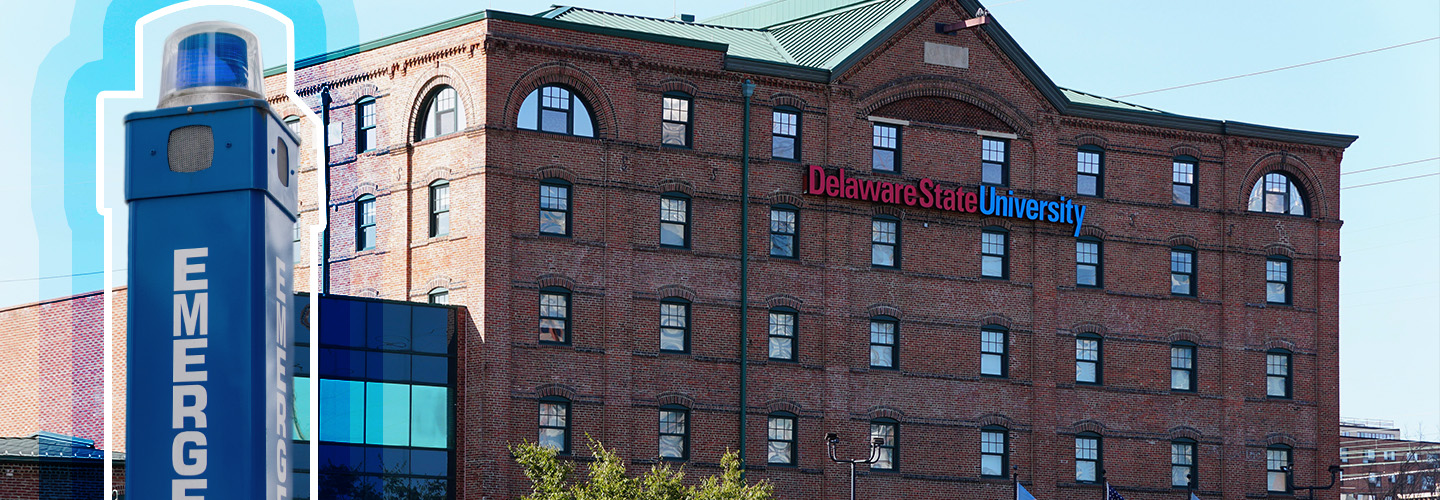
When summer winds down, many families prepare to send students away from home for the first time to attend college. At the same time, colleges and universities nationwide diligently work behind the scenes to welcome students to a safe and secure campus.
Ensuring students enjoy their college experience safely is a top priority for campus safety officials at Delaware State University (DSU). For James Overton, Vice President of Student Affairs and Police Superintendent at DSU, keeping students safe and first responders connected means making the FirstNet network — the nationwide network dedicated to emergency communication — a key part of its campus safety initiative. FirstNet helps ensure that students can reach university police at all times.
Emergency blue light system connects students to campus safety officials
On many college campuses, a common sight is the flashing blue lights of emergency phones placed along walkways, in parking lots, and at other key locations. These phones allow students, faculty, and visitors on campus to connect directly with campus safety officials to report an emergency, such as suspicious activity, medical distress, injuries, or accidents.
For the DSU Police Department, an expansive emergency blue light system serves as one of several parts of their campus safety plan. The system covers DSU’s 400-acre main campus in downtown Dover. When a call button is activated, the blue light phones operate as a two-way voice connection between the caller and campus safety officials.
In most cases, these phones use the same technology as an analog landline phone. While voice communication is valuable, the older technology is subject to some limitations, such as unreliable service or a lack of advanced features.
As a FirstNet subscriber, the campus police department opted to modernize the blue light phone system by connecting it to FirstNet. The improved connectivity on the FirstNet network allowed the cameras to also transmit video footage as a part of the emergency call. DSU campus police gained instant access to a video feed giving them valuable situational awareness about the caller’s situation. This, in turn, improves their ability to lend support to the caller and investigate incidents.
“You’re not just relying on the verbal communication that comes across,” explained Overton. “The dispatcher can see the caller’s surroundings while they relay that information to the [responding] officer.”
Once the blue light system was connected to FirstNet, DSU campus police gained additional benefits that come with FirstNet, such as a prioritized and redundant connection. this translated into quicker access to high-speed data and less interrupted service – two key features that are paramount for safe college campuses.
“That's pretty significant,” said Overton, “And the communication piece is right too. And that’s the big thing. [FirstNet] is reliable.”
FirstNet use: From blue light phones to smartphones and laptops
Blue light phones were only the first step for DSU when implementing FirstNet across the campus. Seeing how FirstNet could help modernize existing security measures for DSU, Overton shared that campus police found other public safety uses for the network.
“We are moving people over to FirstNet because we know how reliable it is. And, in an emergency when it’s crucial that you have communication, I don’t want to say, ‘I wish we would have had that.”
Currently, DSU police officers communicate using FirstNet phones – with plans to equip police cruisers with FirstNet-powered laptops in the near future. Adding this secure mobile connection to their laptops will allow them to expand their abilities to complete their duties and allow them to be accessible to students and effectively communicate while patrolling special events such as homecoming, commencement, and sporting events.
During DSU’s last two homecomings, university police had the opportunity to see their FirstNet-enabled phones in action. With record attendance at the homecoming football games, the approximately 15,000 spectators who packed in and around Alumni Stadium experienced congestion or lost signals on their mobile devices. For DSU police operating on FirstNet, the network held steady, maintaining clear signals and connectivity despite the increased network traffic.
When thinking about the crowds at past homecomings at DSU, Overton said, “It was such a concertation of people here in a small space. We didn’t have any problems getting through. We’re expecting to have really good crowds here [this year]– a good concentration of folks. And we want our phones to work.”
Making campus safety a priority
DSU is committed to creating a safe and secure learning environment so students can thrive while they’re away from home. FirstNet is helping them achieve this goal by providing a reliable network that spans the campus.
For the FirstNet Authority, partnering with campus safety officials is important to our overall mission to ensure the FirstNet is available wherever and whenever our responders are called to duty. FirstNet is built with public safety in mind, and that includes first responders who serve and protect school campuses.