



Southern Utah is known for its dramatic beauty — red rock canyons, national forests, and small towns surrounded by wide-open terrain. But for first responders, that beauty has historically come with a challenge: communications can be difficult, and in some places, non-existent.
“In Washington County, the terrain ranges dramatically,” said Mark Cain, Communications Officer for the Northwestern Special Service District, also commonly referred to as Northwest Fire and Rescue. “From mountain foothills that start around 2,500 feet up to high-altitude plateaus that reach over 6,000 feet, it can be a beautiful challenge for public safety to make a call.”
Northwest Fire and Rescue operates four fire stations in the county. With crews of trained fire and rescue volunteers, the agency protects the communities of Gunlock, Veyo, Brookside, Central, and Mountain Meadows in Washington County.
In 2025, Northwest Fire and Rescue adopted FirstNet, the nationwide public safety broadband network, to help responders better communicate across this vast, complex landscape.
Search and rescue efforts require mobility in the Backcountry
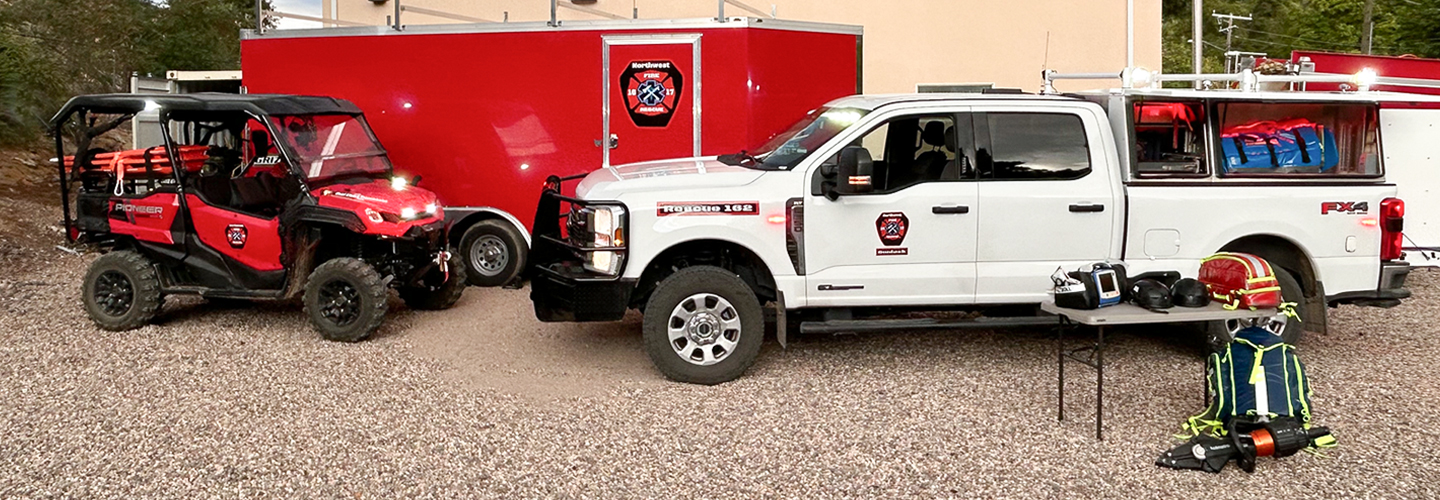
To improve communications in backcountry areas of the county, the department received a state grant for new response vehicles and supporting technology. With the funds, the agency purchased a Ford F-350, Honda UTV, and trailer, and outfitted all three with FirstNet technologies to aid in backcountry rescue.
The UTV allows crews to reach patients deep in rugged terrain. “We’re actually able to do CPR with equipment, heart monitors, IVs — everything — while we’re transporting,” Cain said.
The F-350 and the UTV are equipped with a FirstNet high-power user equipment (HPUE) device. An HPUE boosts signal strength up to six times the normal cellular power to maximize FirstNet’s coverage area. The device can improve the connectivity and data speed of devices when traditional devices might slow or drop off entirely.
“The HPUE coverage is amazing,” Cain said. “We can use it when we’re in another vehicle or 20 car lengths ahead of it moving on the highway. So, everybody can get on to the HPUE that’s in the area.”
The vehicles have supported responses in notoriously dangerous locations like Gunlock Falls in Gunlock State Park and “motorcycle rock curve,” where vehicles have gone airborne before crashing down steep terrain. In those rescues, Cain said, “Without the HPUE we would not be able to deploy the necessary resources as quickly and efficiently because of the historic lack of network connection.”
Recently, the team relied on the UTVs and FirstNet connection to evacuate an injured hiker. “We drove the UTV 25 minutes to the middle of nowhere. Thanks to the equipment, we were able to get into a staging area and then evacuate out quickly,” Cain explained.
When disaster strikes, FirstNet steps in
In July 2025, FirstNet was put to the test when the Pine Valley Fire wreaked havoc through the county. The wildfire began on federal land and quickly spread toward the historic town of Pine Valley, which is surrounded by national forest and Bureau of Land Management property. By the third day, federal agencies assumed command of the incident.
As resources surged into the area, connectivity became strained. “The local cell tower was pretty saturated with federal assets being in town,” Cain said.
FirstNet deployables made the difference.
“We were 48 hours into the fire when our first deployable came — a SatCOLT [Satellite Cell on Light Truck],” Cain said. A second deployable was later added as staging shifted and demand increased. Cain said plainly, “Communicating would be impossible without it.”
The deployables enabled responders to maintain contact with dispatch, coordinate resources, and support evacuations in areas where traditional radio systems struggled. “We have to stay off the radios for tactical purposes,” Cain explained, noting that air resources rely heavily on very high frequency channels. “The FirstNet cellular capabilities were critical in doing command calls so that you’re off the radio for the air resources to use.”
For Cain, the Pine Valley Fire reinforced the importance of seamless interoperability and strong communications — especially among federal partners.
“It’s mission critical for the future. We’re partners in this, and it [FirstNet] saves lives,” he concluded.